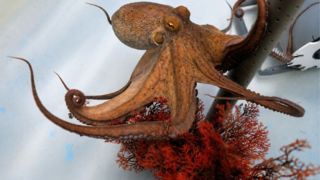
For more than four years, scientists, animal protection organisations and thousands of citizens campaigned to stop the construction of the world's first commercial octopus farm. A few days ago, that effort paid off. Nueva Pescanova announced that it is permanently abandoning its plans for the facility in the Canary Islands, marking a development that goes far beyond the cancellation of a single business project.
The proposal involved breeding and slaughtering up to one million octopuses every year and had sparked strong opposition from scientists, animal welfare organisations and members of the public around the world.
The company stated that its decision was based on business and regulatory considerations. However, it is impossible to overlook the fact that this announcement came after years of coordinated advocacy and public awareness efforts that brought a previously overlooked question into the spotlight. Should every animal that can be farmed become an animal that is farmed?
The octopus is far from an ordinary marine species. It is one of the most intelligent invertebrates known to science. It can learn, remember, solve problems, use tools and adapt its behaviour based on experience. It is also widely recognised by the scientific community as a sentient being capable of experiencing pain, fear and stress. Octopuses are also solitary animals. In the wild, they do not live in groups or spend their lives surrounded by hundreds of others. This natural behaviour is precisely what makes the idea of intensive octopus farming so deeply problematic. An animal that evolved to live alone would instead spend its entire life in high-density tanks within a system designed solely to maximise production.
The opposition to the project was not based solely on ethical concerns. Scientists and organisations also highlighted serious issues relating to animal welfare, the environmental impacts of such an operation, and the enormous demand for marine resources that would be required to feed a carnivorous species such as the octopus.
Nueva Pescanova's decision does not mean that the issue has been resolved once and for all. It does, however, mark an important shift. Society is beginning to question whether there should be limits to what we are willing to do in the name of food production.
The proposal involved breeding and slaughtering up to one million octopuses every year and had sparked strong opposition from scientists, animal welfare organisations and members of the public around the world.
The company stated that its decision was based on business and regulatory considerations. However, it is impossible to overlook the fact that this announcement came after years of coordinated advocacy and public awareness efforts that brought a previously overlooked question into the spotlight. Should every animal that can be farmed become an animal that is farmed?
The octopus is far from an ordinary marine species. It is one of the most intelligent invertebrates known to science. It can learn, remember, solve problems, use tools and adapt its behaviour based on experience. It is also widely recognised by the scientific community as a sentient being capable of experiencing pain, fear and stress. Octopuses are also solitary animals. In the wild, they do not live in groups or spend their lives surrounded by hundreds of others. This natural behaviour is precisely what makes the idea of intensive octopus farming so deeply problematic. An animal that evolved to live alone would instead spend its entire life in high-density tanks within a system designed solely to maximise production.
The opposition to the project was not based solely on ethical concerns. Scientists and organisations also highlighted serious issues relating to animal welfare, the environmental impacts of such an operation, and the enormous demand for marine resources that would be required to feed a carnivorous species such as the octopus.
Nueva Pescanova's decision does not mean that the issue has been resolved once and for all. It does, however, mark an important shift. Society is beginning to question whether there should be limits to what we are willing to do in the name of food production.
Why This Matters to Greece
This development is not only relevant to Spain. Greece is one of the Mediterranean countries where octopus has long been part of the culinary tradition and demand remains consistently high. This places continued fishing pressure on wild populations, which in many areas require careful, science-based management to ensure their long-term sustainability.
At the same time, unlike many other farmed animals, discussions around the welfare of cephalopods are still in their early stages. Over recent years, scientific evidence has increasingly confirmed their ability to experience pain and other negative states, raising important questions about how they are caught, handled and killed.
There have, from time to time, been reports suggesting that similar octopus farming projects were being considered in Greece. However, no officially licensed proposal has emerged. The decision in Spain demonstrates that before such a path is pursued, it is essential to have an informed public debate grounded in scientific evidence and the principles of animal protection.
At A Promise to Animals, we believe that progress should not be measured solely by what technology or industry makes possible. It should also be measured by a society's willingness to recognise that not everything that is technically feasible is ethically acceptable. This decision alone will not change the reality for octopuses. It does, however, show that decisions affecting animals are no longer driven exclusively by technical and economic considerations. Scientific evidence, informed public debate and sustained public pressure can play a decisive role in shaping the future of projects like these.
At the same time, unlike many other farmed animals, discussions around the welfare of cephalopods are still in their early stages. Over recent years, scientific evidence has increasingly confirmed their ability to experience pain and other negative states, raising important questions about how they are caught, handled and killed.
There have, from time to time, been reports suggesting that similar octopus farming projects were being considered in Greece. However, no officially licensed proposal has emerged. The decision in Spain demonstrates that before such a path is pursued, it is essential to have an informed public debate grounded in scientific evidence and the principles of animal protection.
At A Promise to Animals, we believe that progress should not be measured solely by what technology or industry makes possible. It should also be measured by a society's willingness to recognise that not everything that is technically feasible is ethically acceptable. This decision alone will not change the reality for octopuses. It does, however, show that decisions affecting animals are no longer driven exclusively by technical and economic considerations. Scientific evidence, informed public debate and sustained public pressure can play a decisive role in shaping the future of projects like these.