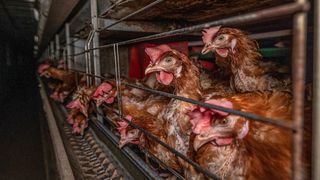
Every week of delay means around two million more hens confined to cages. This comes as powerful industry interests push to keep cages in use until 2045.
More than half a billion hens have been kept in cages across the EU since 30 June 2021, when the European Commission made a written commitment to propose a ban. This first-of-its-kind estimate is based on an analysis of the European Commission’s own egg market data and is being published today as part of a joint action by animal protection organisations across the EU.
The Commission’s 2021 commitment came in response to one of the largest democratic mobilisations in EU history: 1.4 million Europeans signed the “End the Cage Age” European Citizens’ Initiative. Five years later, the legislation has still not been introduced. Every week of delay means that approximately two million more hens are placed in cages. At the same time, agricultural and poultry industry organisations are lobbying behind the scenes to keep cages in use until 2045.
“Each of these hens spends her life in a cage so small that she cannot spread her wings, even though the European Commission had already pledged to phase out this system. And every week that passes without legislation, approximately two million more hens are placed in cages,” said Olga Kikou, substitute representative of the “End the Cage Age” European Citizens’ Initiative. “We are no longer talking about a mere delay. Five years and half a billion hens later, this is a political choice that runs counter to the will of EU citizens.”
The industry’s intentions are well documented. As reported by Grilled and The Guardian, citing published internal documents from COPA-COGECA, the organisation’s then Secretary General told its board that he would defend controversial animal products “in the same way as the tobacco industry”.
Data from the Commission’s own Transparency Register show how this strategy translated into practice. According to an analysis published by Animal Equality in March, the two Commissioners responsible for these issues and their offices met with representatives of the meat, poultry and dairy industries at least 46 times to discuss animal welfare, while meeting with animal protection organisations only seven times.
The picture among citizens is entirely different. The phase-out of cages is supported by scientific evidence from the European Food Safety Authority (EFSA). Nine out of ten Europeans oppose keeping farmed animals in cages. When the European Commission put the issue to a public consultation, 99% of respondents, from a total of more than 190,000 valid submissions, said that phasing out cages for laying hens was important or very important. For the second time, Europeans gave essentially the same clear answer.
Animal protection organisations are now calling for exactly what citizens demanded in 2021: legislation banning cages for laying hens must be introduced now, with the ban fully implemented by 2035. This deadline is based on the industry’s own claims. The industry argues that it needs 15 years to complete the transition. Counting from the Commission’s 2021 commitment, that transition period ends in 2035. By then, the last bird must be out of the last cage. More than half of the transition has already taken place, while several Member States have already completed the move to cage-free systems.
The European Commission now faces a clear choice: either prioritise the interests of powerful industry figures and be remembered for breaking its promise to European citizens, or honour its commitment to 1.4 million people and demonstrate that, when Europeans speak, Europe listens.
“No one is asking the Commission for anything new. We are simply asking it to do what it promised five years ago,” said Olga Kikou. “The Commission can bring this situation to an end. It must introduce the legislation in time to ensure that, by 2035, the last hen is out of the last cage. In doing so, it will demonstrate that the EU keeps its promises to its citizens.”
More than half a billion hens have been kept in cages across the EU since 30 June 2021, when the European Commission made a written commitment to propose a ban. This first-of-its-kind estimate is based on an analysis of the European Commission’s own egg market data and is being published today as part of a joint action by animal protection organisations across the EU.
The Commission’s 2021 commitment came in response to one of the largest democratic mobilisations in EU history: 1.4 million Europeans signed the “End the Cage Age” European Citizens’ Initiative. Five years later, the legislation has still not been introduced. Every week of delay means that approximately two million more hens are placed in cages. At the same time, agricultural and poultry industry organisations are lobbying behind the scenes to keep cages in use until 2045.
“Each of these hens spends her life in a cage so small that she cannot spread her wings, even though the European Commission had already pledged to phase out this system. And every week that passes without legislation, approximately two million more hens are placed in cages,” said Olga Kikou, substitute representative of the “End the Cage Age” European Citizens’ Initiative. “We are no longer talking about a mere delay. Five years and half a billion hens later, this is a political choice that runs counter to the will of EU citizens.”
The industry’s intentions are well documented. As reported by Grilled and The Guardian, citing published internal documents from COPA-COGECA, the organisation’s then Secretary General told its board that he would defend controversial animal products “in the same way as the tobacco industry”.
Data from the Commission’s own Transparency Register show how this strategy translated into practice. According to an analysis published by Animal Equality in March, the two Commissioners responsible for these issues and their offices met with representatives of the meat, poultry and dairy industries at least 46 times to discuss animal welfare, while meeting with animal protection organisations only seven times.
The picture among citizens is entirely different. The phase-out of cages is supported by scientific evidence from the European Food Safety Authority (EFSA). Nine out of ten Europeans oppose keeping farmed animals in cages. When the European Commission put the issue to a public consultation, 99% of respondents, from a total of more than 190,000 valid submissions, said that phasing out cages for laying hens was important or very important. For the second time, Europeans gave essentially the same clear answer.
Animal protection organisations are now calling for exactly what citizens demanded in 2021: legislation banning cages for laying hens must be introduced now, with the ban fully implemented by 2035. This deadline is based on the industry’s own claims. The industry argues that it needs 15 years to complete the transition. Counting from the Commission’s 2021 commitment, that transition period ends in 2035. By then, the last bird must be out of the last cage. More than half of the transition has already taken place, while several Member States have already completed the move to cage-free systems.
The European Commission now faces a clear choice: either prioritise the interests of powerful industry figures and be remembered for breaking its promise to European citizens, or honour its commitment to 1.4 million people and demonstrate that, when Europeans speak, Europe listens.
“No one is asking the Commission for anything new. We are simply asking it to do what it promised five years ago,” said Olga Kikou. “The Commission can bring this situation to an end. It must introduce the legislation in time to ensure that, by 2035, the last hen is out of the last cage. In doing so, it will demonstrate that the EU keeps its promises to its citizens.”